ChaiViz
17.12.2025
The Dream League Season 27 playoffs bracket drops eight elite teams into a double-elimination gauntlet that promises bracket-busting upsets and championship-defining performances. OG enters as the top seed facing immediate pressure from Tundra Esports, while Team Spirit's lower seed placement creates fascinating prediction dynamics for Pick'ems enthusiasts navigating opening round volatility.
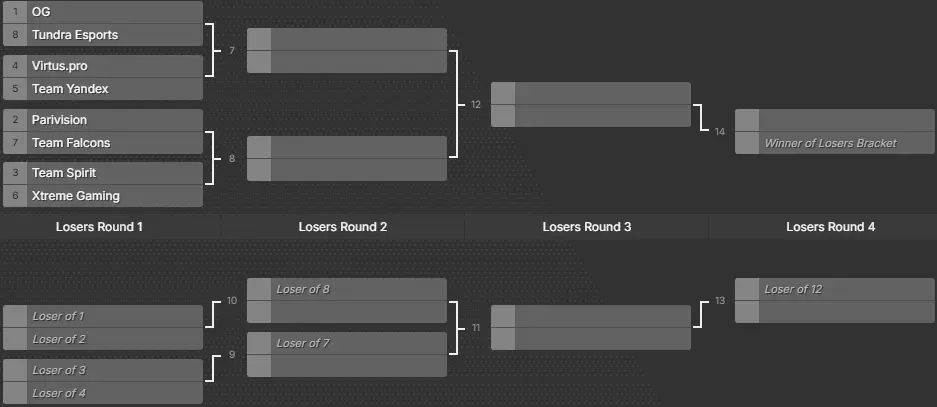
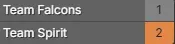
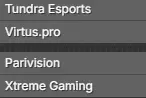
The upper bracket opens with four compelling series that will immediately separate confident predictors from cautious hedgers. OG versus Tundra Esports represents the marquee Round 1 matchup, pitting top-tier execution against dangerous upset potential. Team Yandex faces Virtus.pro in a parallel series where roster depth and recent form will determine advancement, while Team Falcons and Team Spirit both draw theoretically favorable matchups against Parivision and Xtreme Gaming respectively.
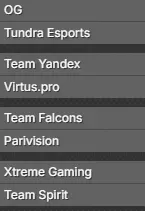
These opening matches create critical decision points for Pick'ems strategy. OG's seeding advantage suggests straightforward 2-0 dominance, but Tundra's tournament pedigree and strategic preparation make 2-1 OG the safer prediction for risk-averse participants. The same logic applies across the bracket, where upset-hunting predictors might target Virtus.pro or Xtreme Gaming for bracket differentiation despite higher risk profiles.
The projected upper bracket progression reveals fascinating strategic considerations for multi-round predictions. If form holds and top seeds advance, OG will face Team Yandex in Round 2 while Team Falcons clash with Team Spirit in the parallel series. Both matchups pit aggressive playstyles against disciplined execution, creating natural tension for prediction models that weight recent results over historical dominance.
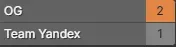
The OG versus Team Yandex projection assumes both teams navigate opening round challenges, but this series represents genuine championship contender collision. Team Yandex's tactical flexibility could exploit OG's occasional draft rigidity, while OG's superior late-game decision-making provides safety nets that Team Yandex lacks in critical moments. A 2-1 OG prediction balances these factors, acknowledging upset potential while respecting seeding advantage.
Team Spirit versus Team Falcons offers equally compelling prediction dynamics. Team Spirit's recent tournament performances suggest championship-caliber form, but Team Falcons' roster improvements and meta adaptation create legitimate threat potential. This matchup likely determines which organization claims the upper bracket finals spot opposite OG, making it essential for bracket predictions seeking maximum point accumulation.
The lower bracket structure punishes early mistakes while rewarding adaptability and mental resilience. Teams dropping from upper bracket Round 1 face immediate elimination pressure against lower bracket Round 1 survivors, creating fascinating stylistic clashes between tournament-tested rosters and elimination-desperate underdogs. Tundra Esports' projected lower bracket appearance after an OG loss positions them as dangerous comeback candidates with championship experience.
The grand finals prediction represents the tournament's ultimate decision point for competitive analysis enthusiasts. An OG versus Team Spirit finals matchup appears most likely based on bracket positioning and recent form indicators, but Team Falcons' upset potential and lower bracket dangers like Tundra Esports create multiple plausible championship scenarios.
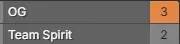
OG's path through the upper bracket without facing elimination provides strategic advantages in draft preparation and momentum maintenance. However, Team Spirit's championship experience and recent major tournament performances make them equally credible grand finals predictions despite lower seeding. The projected 3-2 OG victory in finals acknowledges Team Spirit's threat level while respecting upper bracket advantage and OG's current form trajectory.
For Pick'ems participants seeking leaderboard differentiation, the lower bracket provides multiple upset opportunities worth calculated risks. Xtreme Gaming could surprise Team Falcons in Losers Round 3 if the bracket develops as projected, while Team Yandex versus Tundra Esports in Losers Round 2 offers genuine toss-up dynamics where bold predictions might separate leaders from the pack.

The tournament's best-of-three format through semifinals creates natural variance that rewards analytical prediction approaches over simple seeding-based models. Teams that adapt quickly between maps and adjust draft strategies mid-series will outperform mechanically superior opponents who lack tactical flexibility. These dynamics favor experienced rosters like Team Spirit and Tundra Esports in potential upset scenarios.
Conservative Pick'ems strategy suggests following seeding through Round 1, then incorporating recent form and head-to-head results for deeper bracket predictions. OG, Team Yandex, Team Falcons, and Team Spirit advancing from opening matches represents the chalk scenario that likely dominates public prediction pools. Differentiating requires calculated risks on specific matchups where upset indicators justify the negative point exposure.

Aggressive prediction strategies might target Tundra Esports for a Round 1 upset over OG, immediately separating from conventional wisdom while accepting higher bust potential. Similarly, Virtus.pro over Team Yandex or Xtreme Gaming over Team Spirit provides bracket differentiation opportunities for participants willing to sacrifice safe points for leaderboard positioning advantages.
The Dream League Season 27 playoffs offer multiple decision points where analytical depth and strategic courage will determine Pick'ems success. Understanding team form trajectories, draft pool advantages, and meta adaptation capabilities separates recreational predictions from competitive analysis that consistently generates positive point returns across multiple tournaments.
ChaiViz
17.12.2025
Article TAGS
News Feed


Welcome to The Weekly Ward: Meme Vision, your weekly reconnaissance into the best Dota 2 community humor. Just like a well-placed ward reveals enemy movements, we're here to provide vision into the memes that defined the week.
Team Vision closed the Swiss stage with a flawless run, Team Liquid and Nigma Galaxy joined them in a direct trip to the playoffs, and a brutal elimination round wiped every Chinese organization out of TI 2026 on home soil in Shanghai.
PGL Wallachia Season 8 kicks off in Bucharest with eight Round 1 Swiss matches, and your Pick'ems points start here. These are the safest calls and the ones worth thinking twice about before you lock in.
PARIVISION claim the inaugural NarodCast PREMIER SERIES title, sweeping through the entire playoff bracket without dropping a map to take home the $50,000 first prize.
Welcome to The Weekly Ward: Meme Vision, your weekly reconnaissance into the best Dota 2 community humor. Just like a well-placed ward reveals enemy movements, we're here to provide vision into the memes that defined the week.
The Road to The International 2026 begins in Shanghai, with sixteen teams battling through a Swiss system group stage where only the top three punch a direct ticket to playoffs, and three rosters look built to clear that bar.


Wang "Ame" Chunyu has over $4.4 million in career earnings, three TI Grand Final appearances, and still no Aegis. No carry in Dota 2 history has come closer without winning it all.
Patch 7.41 is one of the most structurally disruptive updates in recent Dota 2 history, stripping Facets from the game, overhauling innate ability scaling, reshaping the map, and delivering changes to well over 50 heroes.
DreamLeague Season 29 tips off on May 13 with 16 elite squads chasing $1,000,000, 28,300 EPT points, and the final direct invite to Esports World Cup 2026. Here is the full group breakdown and the teams to watch.
Twenty-four teams, four groups, one shot at Paris glory. Here are our picks for the two sides that will escape each group at the Esports World Cup 2026.